
Transcending the Darkness

Greetings, dear Soul! Sunday the 14th is K’ een 143, Transcending Dusk, where the soul enters the sacred passage of Dusk-Night-Dawn and learns that every ending is also a threshold of Ascension. It is also the final day of this current Pulse-Wave, and thus, Tone 13 bundles the journey into the Shape of the Sphere enclosing the sacred Cube, where Karma, Destiny, the Ancestors, and Unconditional Forgiveness circle around us, not as abstract ideas, but as living presences helping us integrate what the long night has revealed.
The Nagual of Dusk brings us into the dwelling place of Mystery, Dreams, Secrets, and Intuition, where the bat flies through Xibalba and the hidden self begins to remember its own renewal. This is the sanctuary between worlds, where Polarity and Duality soften into Truth, where Hope is born quietly in the dark, and where Cosmic Consciousness teaches us to stop forcing the dawn and start allowing the next life to dream itself awake within us. Here’s all the Codes:
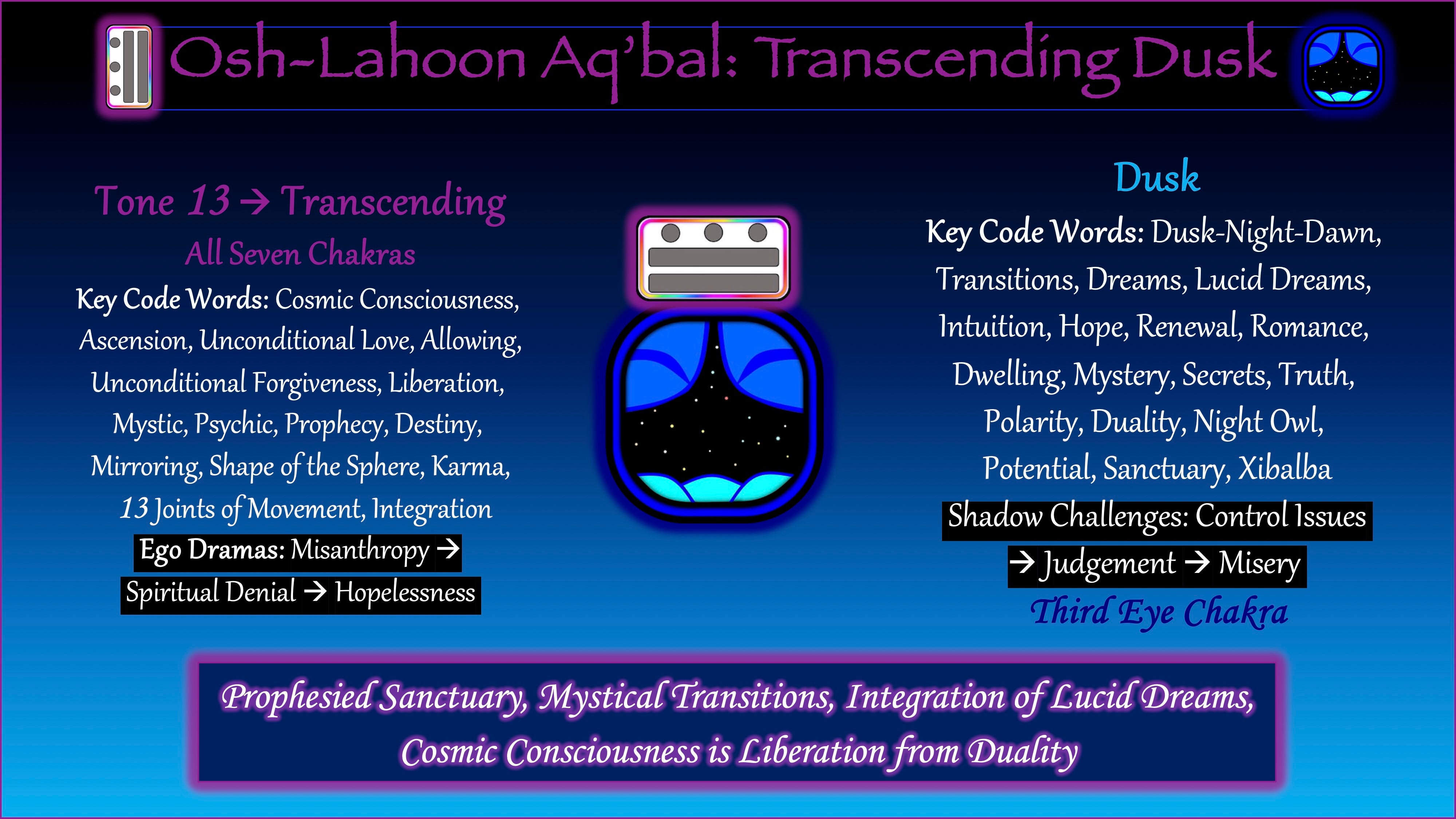
The Shadow Ego of Transcending Dusk can fall into Misanthropy, Spiritual Denial, Hopelessness, Control Issues, Judgementalism, and Misery. When the night feels too long, the wounded ego may decide that humanity is hopeless, that Spirit is absent, that renewal is impossible, and that the only safety comes from controlling the outcome. Dusk teaches otherwise. The cave, the dream, the bat, the secret chamber, and the descent into Xibalba are not punishments. They are initiations. Today asks us to soften the grip, stop condemning the darkness, and remember that dawn is not created by force. Dawn is allowed and embraced.
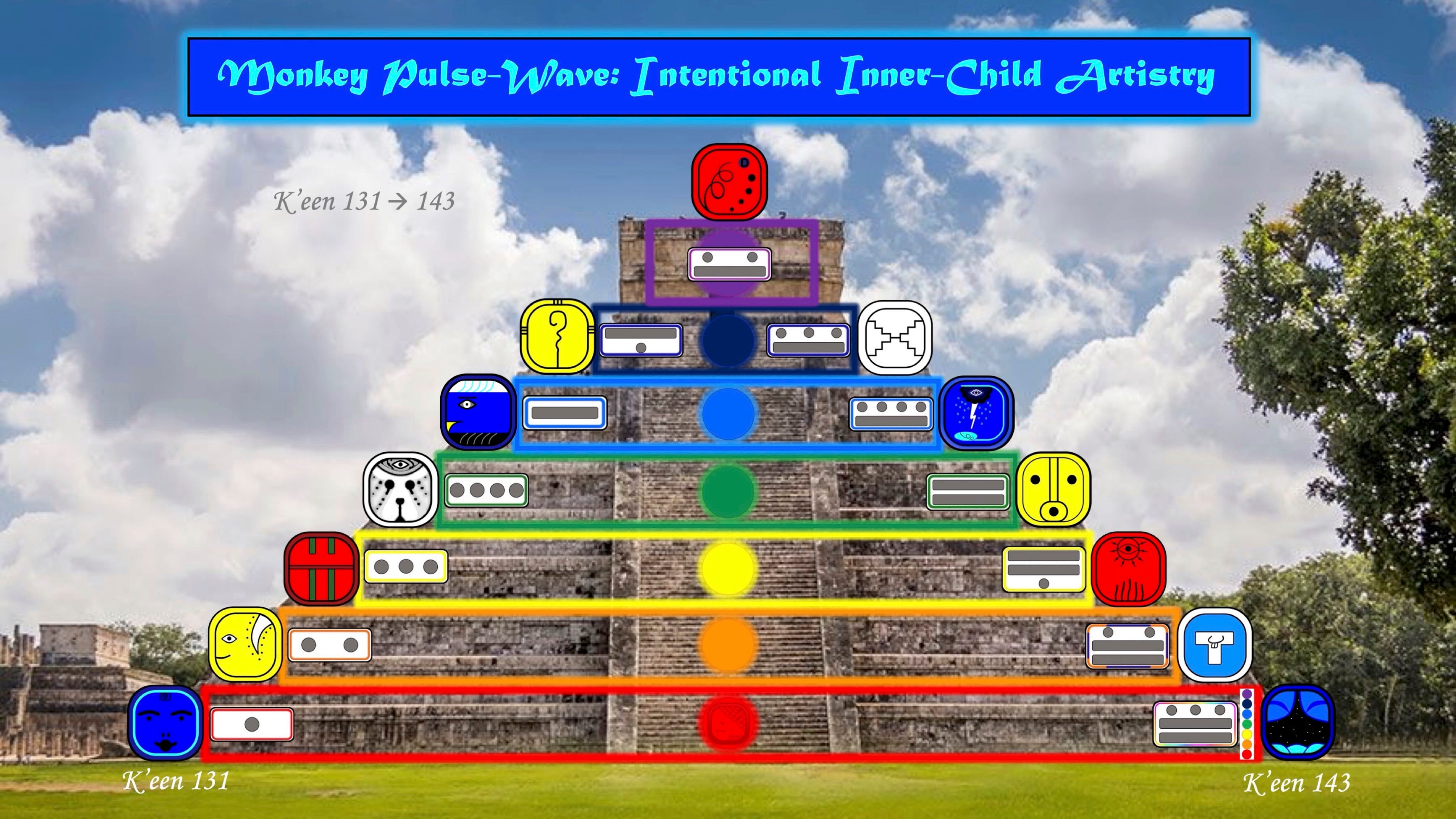
Do you remember where we’ve been in the previous 12 days?
Shine a Light on the Shadow Ego
How might Misanthropy be closing my heart to the wounded beauty of humanity?
Am I using Spiritual Denial to avoid the deeper message hidden inside this transition?
What part of me has mistaken Hopelessness for truth, when it may only be the voice of the long night?
How are Control Issues keeping me from trusting Mystery, Dreams, Intuition, and renewal?
In what ways does being Judgemental protect me from feeling vulnerable, uncertain, or afraid?
What old story of Misery am I ready to stop treating as my permanent dwelling?
Now, as one would expect, with the energy of K’ een 143, we have some very potentiating Exemplars:
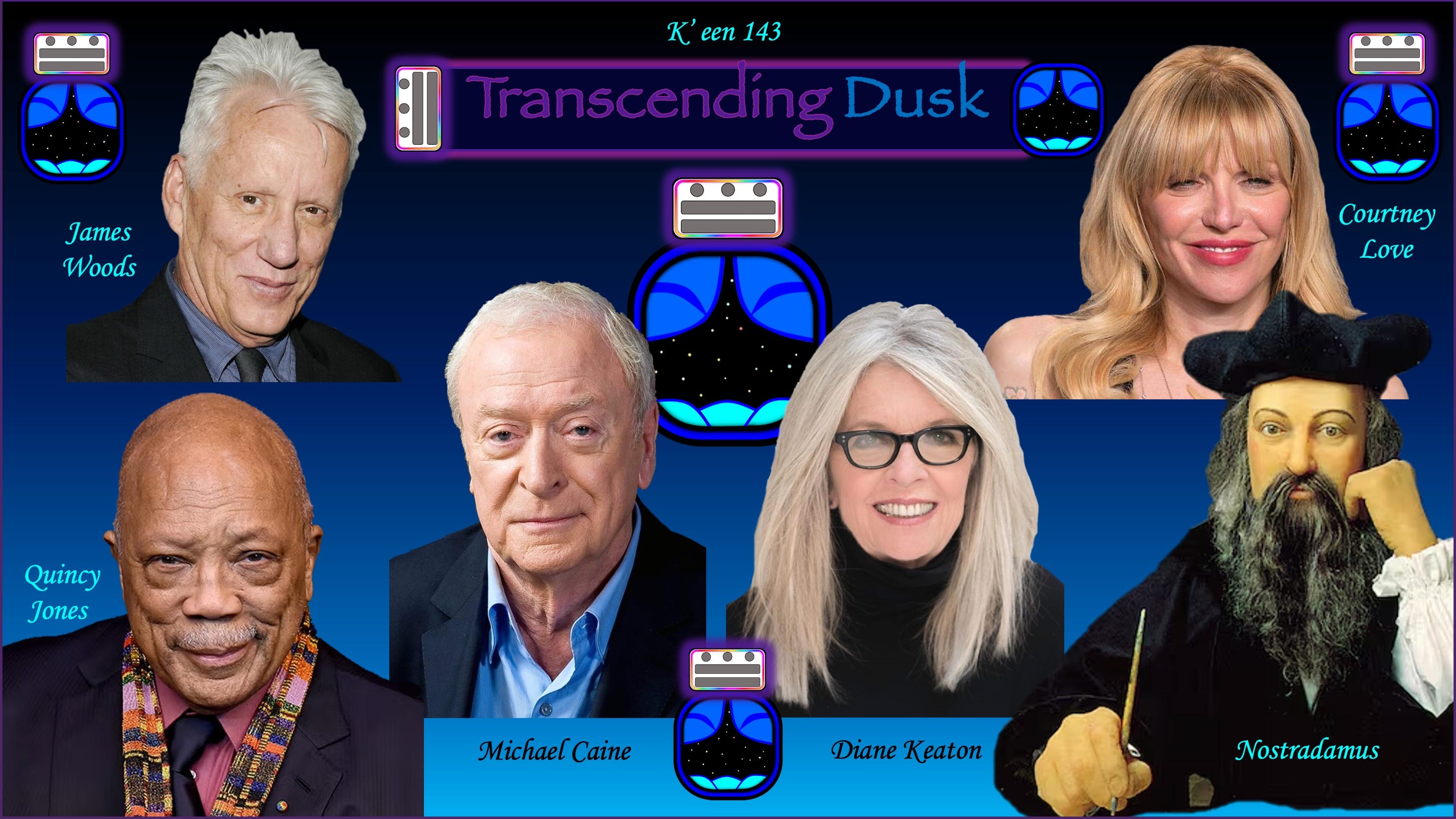
Our first Exemplar is Diane Keaton, who lived Transcending Dusk through her luminous uniqueness, emotional intelligence, and refusal to become a standard Hollywood shape. From The Godfather to Annie Hall, Reds, Baby Boom, Father of the Bride, The First Wives Club, and Something’s Gotta Give, she carried the Dusk codes of polarity, romance, mystery, vulnerability, and renewal into the public imagination.
She often played women standing at thresholds: between innocence and power, love and independence, comedy and grief, sanctuary and exposure. And as i’ve been saying for the last 3 years of writing this blog, an “actor” is not really “acting” any more than any human being is acting out their lives.
In her best work, Diane made awkwardness holy. She showed us that the soul does not have to be polished to be radiant. It can be eccentric, hesitant, funny, wounded, stylish, strange, and still completely full of light.
Her Shadow Ego story speaks through privacy, emotional guardedness, and the ache of the hidden interior life. Diane Keaton never married, adopted her children later in life, and often carried an image of quirky independence that could also suggest distance from conventional intimacy. This does not mean failure. It means Dusk.
Her life reminds us that sanctuary can be beautiful, but it can also become a shelter from full exposure. The lesson is not to judge the mystery of another person’s heart, but to ask where our own private rooms have become too sealed, where independence becomes control, and where the fear of being fully known can quietly become loneliness.
Courtney Love embodies Transcending Dusk in a far more raw, loud, and volcanic form. As the frontwoman of Hole, she turned grief, rage, glamour, trauma, romance, and female survival into jagged altar music. She did not sing from the safe side of the veil. She sang from the underworld, from the hotel room, from the torn dress, from the tabloid fire, from the place where the dream has curdled but still refuses to die. In her, Dusk becomes the scream before dawn, the bat-winged passage through Xibalba, the messy prophecy of a woman determined to reclaim her own story.
Her Shadow Ego material is also public and intense: addiction struggles, conflict, grief, estrangement, and the long cultural habit of making her into a villain after Kurt Cobain’s death. Courtney’s life shows how quickly Misery and Judgementalism can become a collective ritual, with the crowd projecting its shadows onto one wounded figure. It also shows how Control Issues can emerge when a person has been publicly misread for decades.
Yet the medicine of Transcending Dusk is still present: survival, sobriety, creative return, and the possibility that even the most demonized night can become a doorway to renewal. She rose from the darkest night of the Shadow Ego into a bright new Dawn. More recently, Courtney has been publicly described as sober, living a quieter life in London, UK, and reclaiming her own story through the documentary Antiheroine and new music. Not surprisingly, she has revealed that childhood trauma is the root of all her addictions and relationship issues.
Michael Caine carries Transcending Dusk through a long arc of craft, class transition, endurance, and late-life integration. Born Maurice Micklewhite, he emerged from working-class London into one of the most recognizable screen presences in the world, moving through Alfie, The Italian Job, Get Carter, Educating Rita, Hannah and Her Sisters, The Cider House Rules, The Dark Knight trilogy, and many more.
His voice alone became a sanctuary of character: grounded, dry, knowing, humane. My favorite movie with him in it is Interstellar, such a great role, which peaked with his melodious voice reciting the whole of Dylan Thomas’s famous poem, “Do not go gentle into that good Night. Rage, rage against the dying of the light.”
If only he knew his Mayan birthday, it would have doubled the intensity of that poem. In him, Dusk is the elder at twilight, looking back across a vast road and allowing the many roles, masks, and destinies to gather into one completed sphere.
His Shadow Ego lessons are subtler. Caine’s long career included typecasting, reinvention, and the difficult business of remaining visible as youth-obsessed industries move on. There is a Dusk challenge in knowing when to continue and when to release, when ambition is still destiny and when it becomes attachment. His eventual retirement from acting in his 90s gives us a clean Transcending lesson: completion is not defeat. The curtain falling is not hopelessness. Sometimes the most graceful act is to allow the final scene to be final.
Quincy Jones embodied Transcending Dusk a master of integration, collaboration, and musical prophecy. Quincy did not merely make records. He built bridges between jazz, pop, soul, film, television, orchestration, and global culture. From Count Basie and Frank Sinatra to Michael Jackson, from The Color Purple to We Are the World, from arranging and composing to producing Thriller, he embodied Tone 13’s gift for gathering many streams into one sphere.
In him, Dusk became the studio after midnight, the room where secret harmonies are heard before the world knows they exist. He was a dream architect, a frequency translator, and an ancestor-in-training long before he crossed the veil.
His Shadow Ego work can be seen in the tremendous pressure of genius, ambition, and influence. A person who can hear the whole arrangement may be tempted to control the whole room. Quincy’s life also included complicated relationships, multiple marriages, and the human cost of vast creative hunger. This is not a condemnation; it is the Dusk teaching. The greater the gift for integration, the greater the need for humility, tenderness, and forgiveness. Quincy’s legacy asks us to remember that mastery is not only the ability to shape sound. It is also the ability to let love remain louder than control.
James Woods lives Transcending Dusk codes through intensity, intelligence, sharp perception, and an ability to inhabit morally complex characters. His screen presence has often been fast, edgy, brilliant, suspicious, dangerous, or wounded, making him a natural vessel for mystery, secrets, polarity, and psychological shadow.
In films such as Salvador, Videodrome, Once Upon a Time in America, Casino, and many others, he has shown the viewer characters who stand at unstable thresholds, where truth and corruption, charisma and menace, insight and obsession all blur together. He is not a soft Dusk figure. He is the flicker in the alley, the nervous system in the dark, the mind that sees too much and cannot easily rest.
His Shadow Ego is connected to the public combativeness and polarizing tone that has surrounded him, especially in the social media era. This is where Dusk can slip into Judgementalism, Control Issues, and Misery: the sharp eye becomes the sharp tongue, the search for truth becomes suspicion, and intensity hardens into division. His example reminds us that perception is powerful, but without forgiveness it can become a weapon. The medicine is not to lose the sharpness, but to place it in service of wisdom rather than war.
Our final Exemplar is Nostradamus, perhaps the most obvious Transcending Dusk figure of the day. A physician, astrologer, and writer of prophetic quatrains, he became a symbol of the night-seer: the one who peers through plague, history, empire, catastrophe, and uncertainty, then speaks in riddles from the edge of the known world.
His Centuries are Dusk texts, filled with mystery, symbolic language, shadowed futures, and dreamlike fragments that people have interpreted for centuries. Whether one sees him as prophet, poet, astrologer, or cultural mirror, Nostradamus belongs to the threshold between night and dawn, where intuition tries to give form to what has not yet arrived.
His Shadow Ego lesson is the danger of prophecy becoming projection. Vague visions can inspire awe, but they can also feed fear, fatalism, conspiracy, and Hopelessness. The Dusk gift is mystery, but the Dusk shadow is misery dressed as destiny. Nostradamus reminds us to handle prophecy carefully. The future is not meant to imprison us. A true vision should awaken responsibility, humility, and reverence, not panic or doom. The sacred seer does not merely predict the dark. The sacred seer helps the people find the dawn.
Together, these six Exemplars create a powerful Transcending Dusk constellation. Diane Keaton brings the holy awkwardness of the private soul. Courtney Love brings the wounded scream that refuses erasure. Michael Caine brings the elder’s graceful completion. Quincy Jones brings the cosmic arrangement, weaving many voices into one living field.
James Woods brings the sharp, dangerous intelligence of the shadowed mind. Nostradamus brings the prophetic dreamscape of history itself. Each one stands at a threshold, reminding us that Dusk is not the end of the Light. Dusk is the chamber where the next Light is conceived. Now here’s their Guides:
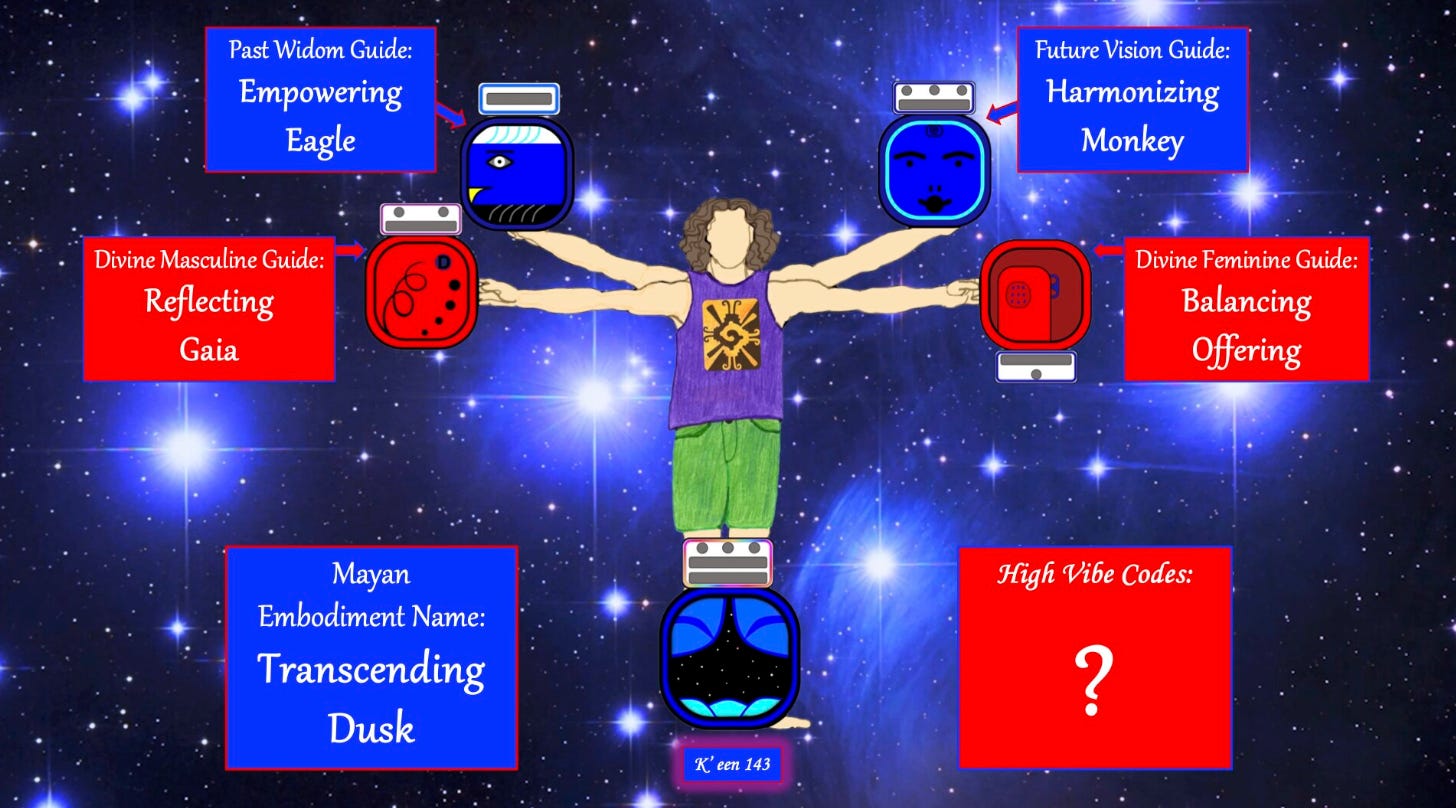
For those of my new followers who are unsure of what the right hand box with the ? represents, i personally create High VIbe Codes for my clients after they respond to my questions that are here and i also create them without my clients answering them. My intuition is fully engaged.
Empowering Eagle soars above the concerns of the daily world with a Throat Chakra screeching its messages for all to hear. With Nostradamus, this connection is obvious, and with Courtney, it is too…
Balancing Offering is asking that the family be kept sacred and close to one’s heart. Diane hopefully experienced this later in life.
Reflecting Gaia is an homage to all living creatures, and the endlessly complex thought forms that go into making them, seen from the perspective of a liaison at the top of the pyramid.
Harmonizing Monkey is an extremely creative influence, demostrative, attention seeking, and has the edge of “by any means necessary”, which fits nicely into the lives of all our Exemplars, if I do say so myself.
As for you and me today, the message is to stop fearing the passage between worlds. Let the past fade away naturally. Let the mystery breathe. Let the cave speak. Let the ancestors gather around the sphere of your life and show you what is ready to be forgiven, integrated, released, and renewed.
Reflect upon these last 13 days. Have you achieved anything important? Did you set an intention with Initiating Monkey? That’s how the Divine Mayan Tzolk’ een works, you know. Every Tone 1 day you anchor in the new energy, and intentionally participate in its unfolding.
Transcending Dusk asks us to look at our Sacred Inner Child, and asks if we are doing what we need to let it thrive. It does not ask us to pretend the night is easy. It asks us to remember that the night is alive, intelligent, and filled with hidden doorways to precious dreams. If we can soften our control, release our judgments, and refuse the seduction of hopelessness, we may discover that dawn has been forming inside the darkness all along.
Now you, dear Soul, can ONLY transcend your inner darkness by embracing it, and loving all your foibles and faults. I can help you do that with a Mayan Embodiment reading. It is my spiritual reason for living.
With Unconditional Love and Universal Truth,
Thirteen Thank Yous and Long Life of Honey in the Heart,
Een Lak’esh, Ala K’ een means I am You, You are Me, We are One, One Divinity.
Namaste,
crispy